gif-icon
search-icon mic-icon
location-marker

Enter your pincode

Explore product availability and delivery choices

8 Dec, 2025

Which type of water purifier should you use for borewell water?

Latest Water Purifier
water purifier for borewell water

Water purifiers are essential today in an increasingly polluted world. Water purifiers are not just a simple machine that cleans your water; they have changed just as much as your water has in today’s world. The most common problem in India is that households get borewell or hard water, which is very unhealthy for drinking. Choosing the best water purifier for borewell water is crucial.

This blog will be your guide to ‘how to choose the best water purifier for borewell water or hard water.’


Common Issues with Borewell Water 


Since borewell waters come from underground, usually from collected rainwater, water seeped into the ground near rivers and lakes, and melted snow, they are highly saturated. It is also very highly contaminated with chemicals like fluoride, arsenic, and microbials and heavy metals, which make it unfit for drinking. 


Borewell water stains and leaves an odour, and carries several waterborne diseases since it comes from below the ground without any filtering.  


Why Ordinary Filters Don’t Work for Borewell Water 


Ordinary filters fail to filter borewell water since they are highly saturated. Ordinary filters may not be able to filter out heavy metals and chemicals from borewell water. Standard or basic water filters are not designed to purify hard water with numerous contaminants, and therefore, fail to filter the water to make it fit for drinking purposes. 


Ordinary water filters are not typically equipped with multiple-stage purification systems, such as Reverse Osmosis (RO), Ultraviolet (UV), and Ultrafiltration (UF). Why ordinary filters fail: 


  • Very high total dissolved solids (TDS)levels in hard water 


  • Limited water purification capacity in normal filters 


  • Filtration technology might be ineffective against specific contaminants. 


Best Types of Water Purifiers for Borewell Water 


Choosing the right water filter for bore water is crucial. Many brands offer a range of features in various models at different price points to help you find the best water purifier for your home. Some options to consider:


AO Smith Pro Planet P6 RO+SCMT Water Purifier


Offers an 8-stage purification system, mineral technology, and advanced recovery technology (ART).


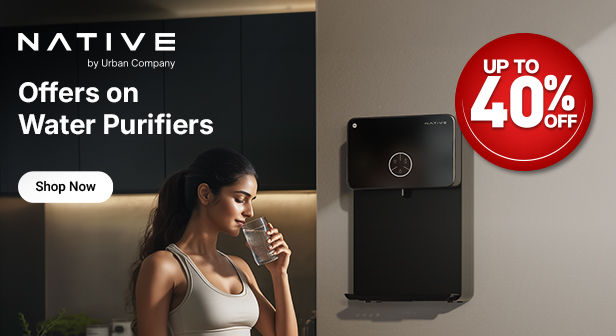
Native by Urban Company M1 Water Purifier


Offers 10-stage water purification, in-tank UV technology that enhances water in the tank, featuring a two-year filter life for long-lasting and uninterrupted filtering.  


Eureka Forbes Aquaguard Aspire Blaze Hot


Offers RO+UV+Taste Adjuster (MTDS) technology, Active Copper and Zinc Booster, Hot and Ambient water options, and an energy-efficient design that ensures safe and great-tasting water for every home.


Eureka Forbes Aquaguard Enrich Superio Water Purifier


Offers RO+UV e-boiling purification, advanced Active Copper Zinc Booster Technology, mineral guard for essential minerals, and energy-saving mode for efficient and healthy water purification.


Pureit Copper+ Eco Mineral RO+UV+MF Water Purifier


Offers RO+UV+UF water purification, copper charge technology, precise copper dosing to make your water fit to drink, advanced 7-stage water purification, and intelligent copper auto-cleaning.   


Kent Grand Plus Water Purifier


The Mineral RO water purifier offers RO+UV+UF water purification, in-tank UV disinfection, and zero water wastage technology. 


HAVELLS Gracia Alkaline Max Water Purifier


Offers 7 stages of RO, UV, and alkaline purification, a sediment filter, and a filtration capacity of 15 litres per hour.  


How to Choose the Right Purifier?


The best water purifiers depend on household to household on various factors. Choosing the right borewell water purifier is crucial, based on your specific mineral requirements and usage. Factors to consider:  


  • Water type and source of water 


  • Purification technology 


  • Size and space available 


  • Price 


  • Maintenance 


  • Smart features 


  • Storage capacity 


Conclusion

Choosing the right borewell water purifier is like choosing a lifestyle for you and your family. Understanding why ordinary filters fail to filter borewell water, as well as the importance of a specialised borewell water filter, is also essential. Compare water purifiers across brands, models, and prices with ease at Vijay Sales


Selecting the right water filter for your home is crucial, and several factors should be considered when making this decision. Here are all the answers on which water filter for borewell water to buy, and it helps you understand the whys and hows as well.

Frequently Asked Questions

faq1

faqsQuestions
Why is borewell water considered unsafe for direct consumption?
faqsAnswer

Borewell water is sourced from collected rainwater, melted snow, and water seeped into the ground from rivers and lakes, which makes it highly contaminated with chemicals, microorganisms, and heavy metals, making it unsafe for drinking.

faq2

faqsQuestions
Which water purifier is best suited for treating water from a borewell?
faqsAnswer

Water purifiers for treating borewell water should have a multiple-stage water 

purification system for best results, incorporating purification methods such as RO, UV, and UF. Filters that infuse water with copper and zinc also have their advantages.

faq3

faqsQuestions
How does an RO water purifier help in purifying borewell water?
faqsAnswer

RO water purifiers filter hard water using a semi-permeable membrane, which removes heavy metals and chemicals from the water, thereby reducing TDS and making the water softer and purer, ultimately making it suitable for drinking.

faq4

faqsQuestions
Is UV purification alone enough for borewell water?
faqsAnswer

No, UV purification alone is not sufficient to purify borewell water, as it only kills bacteria but is unable to remove heavy metals and reduce TDS levels in the water. UV is an additional water purification method to look for in water purifiers, not the only one.

faq5

faqsQuestions
What role does the TDS level play in choosing a purifier for borewell water?
faqsAnswer

TDS is the total dissolved solids in the water. A high TDS indicates the presence of numerous undissolved solids in the water, rendering it unfit for drinking purposes. A low TDS indicates a deficiency of essential minerals in the water. TDS level should range between 150-300ppm for safe and healthy drinking water.

faq6

faqsQuestions
Can borewell water purifiers remove hardness and excess salts?
faqsAnswer

Yes, borewell water purifiers can usually remove hardness and excess salts from water using their multiple water purification systems and RO+UV+UF methods of water purification.

faq7

faqsQuestions
Do I need a water softener in addition to a purifier for borewell water?
faqsAnswer

No, a water softener is generally not required along with a purifier for borewell water. Water purifiers for borewell water soften the water using their multi-stage water filtration systems and RO+UV+UF methods of water purification.

faq8

faqsQuestions
How often should borewell water purifiers be serviced or filters replaced?
faqsAnswer

A borewell water purifier needs regular maintenance, every six to twelve months, depending on its usage. Specific filters require servicing based on their type and the quality of the water. RO filters need to be serviced or replaced every 1-3 years, depending on usage, while UV lamps require servicing every 9-12 months.

faq9

faqsQuestions
Can borewell water purifiers handle high iron and fluoride content?
faqsAnswer

Yes, borewell water purifiers are generally equipped with RO methods of water purification and can handle high iron and fluoride content. A multi-stage water purification system typically does this as well, depending on the level of iron and fluoride content in the water.